
Coding, Robotics or AI: Which Should My Child Learn First?
Discover how to choose the right technology pathway for your child by understanding the differences between coding, robotics, and artificial intelligence based on age and interests.
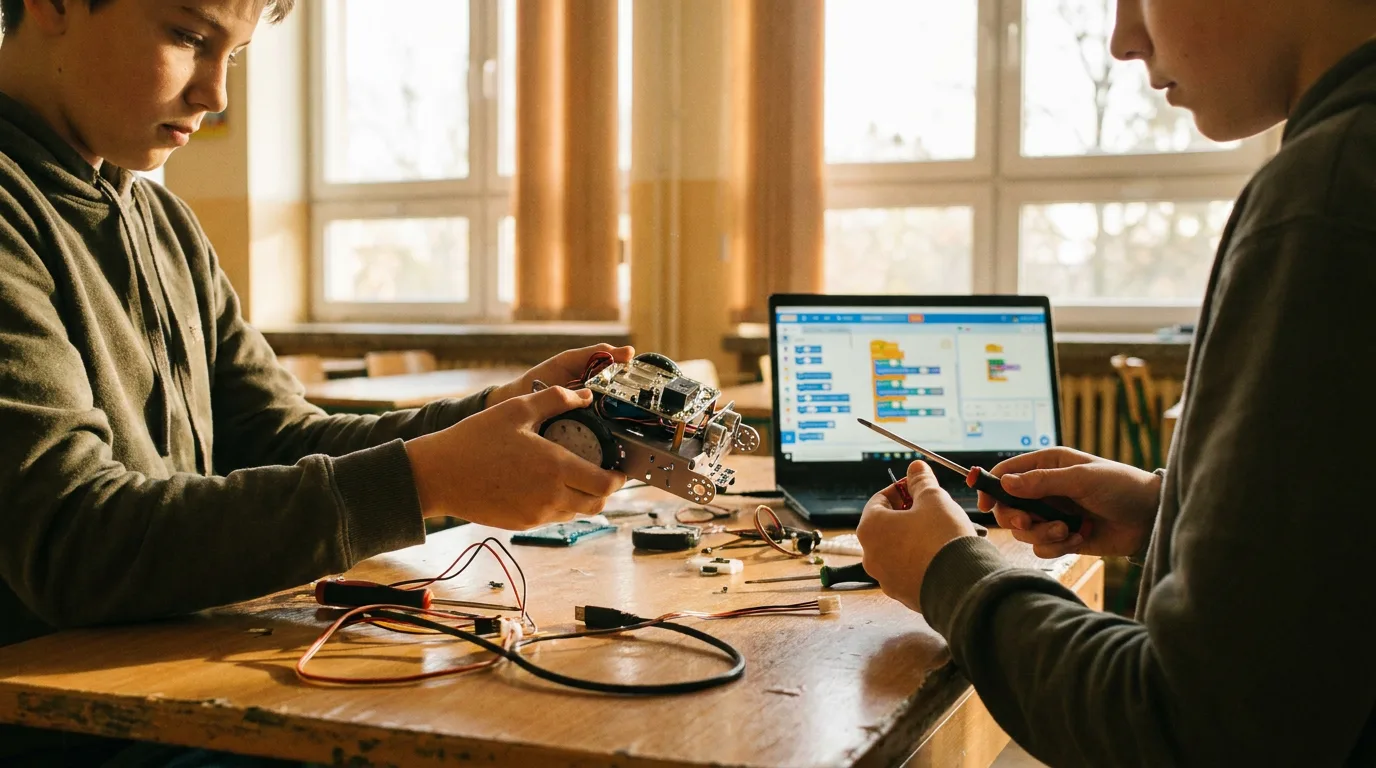
You have decided that your child should learn more about technology. Then you start looking for classes: coding, robotics, artificial intelligence, STEM, game development, electronics, Python, and Scratch. Suddenly, one decision creates ten more.
Parents are increasingly told that children need technology skills for the future. But that does not answer the practical question: what should my child actually learn first? The best starting point depends on three things: age, interests, and how the child likes to solve problems.
What Is the Difference?
Parents often see coding, robotics, and AI advertised together. They overlap, but they are not the same.
Coding
Coding means creating instructions that a computer can execute. Children may begin with visual programming systems where they connect blocks together. Later they can progress to text-based programming languages such as Python or JavaScript. Coding is particularly useful for developing logical thinking and understanding how software works.
Robotics
Robotics brings programming into the physical world. Instead of simply seeing something happen on a screen, the child may programme a machine to move, turn, or detect objects. Robotics can combine coding with engineering, mechanics, electronics, and design, making technology much more tangible.
Artificial Intelligence
AI education teaches children how intelligent computer systems work, what they can do, and how they should be used responsibly. At more advanced levels, students may explore data, algorithms, and artificial intelligence models. However, AI education needs to change dramatically with age.
Choosing the Best Starting Point
For many younger children, I would not automatically start with AI. I would usually begin with coding or robotics because children benefit from understanding basic cause and effect. This creates a fundamental understanding that technology follows systems and instructions.
Ages 6–9: The Advantage of Robotics
For many children in this age group, robotics has one major advantage: they can see the result. The cycle of idea, attempt, failure, adjustment, and success is one of the most valuable aspects of a good STEM workshop or programme.
Ages 8–12: Developing Precision
As children's mathematical thinking and attention develop, programming can become more sophisticated. Visual tools can lead toward text-based languages. This is an excellent age to introduce the idea that computers do exactly what you tell them, which is the foundation of debugging.
Identifying Interests
Follow your child's natural behaviour to find the right fit:
If they love building with LEGO or taking things apart, consider engineering or robotics.
If they love video games, game design may be an excellent gateway into coding.
If they are very creative, they might enjoy digital creativity such as animation or 3D modelling.
Recognising a Quality Class
Do not be overly impressed by technical vocabulary. A strong programme should increasingly involve creating, experimenting, and problem-solving. Children should not spend the entire lesson copying the teacher's code line by line. Whether they are learning computer basics or advanced machine learning, the quality of the teacher and the opportunity to experiment matter most.
There is no race. Your child does not need to master every tool by a certain age. The most valuable thing you can give them is the confidence to look at unfamiliar technology and know they can figure it out.