
What STEM Skills Will Children Really Need in an AI Future?
Preparing children for a future with AI requires more than just learning to code. Discover why critical thinking, mathematics, and adaptability are the most durable skills for the next generation.
Parents are facing a strange educational problem: we are preparing children for a future we cannot clearly see. A few years ago, the advice seemed simple: teach your child to code. Then artificial intelligence began writing code. Parents were told that learning languages was essential; now AI can translate almost instantly. So, what abilities will still matter when the technology changes?
We Cannot Predict Your Child's Job
Imagine trying to explain today's workplace to a parent in 1995. Many modern roles, from cloud architects to machine-learning engineers, did not exist. By 2045, when today's young children enter their professional careers, the market will have shifted again. A better strategy than preparing for one narrow profession is developing abilities that remain useful across many possible futures.
The Most Important Skill May Be Learning How to Learn
Technology changes quickly, making adaptability extraordinarily valuable. A child who approaches a new system with the mindset that they haven't learned it yet is in a stronger position than one who feels defeated by the unknown. This mindset may be the most important form of future readiness.
Critical Thinking and AI Literacy
AI creates enormous quantities of information, meaning humans increasingly need to evaluate it. Children need to learn to ask how we know something is true and what evidence supports it. Developing AI / digital skills involves understanding what these tools can and cannot do, and why they make mistakes.
Mathematics and Coding Still Matter
Mathematics is not simply manual calculation; it teaches logic, probability, and relationships. Similarly, programming helps children understand automation and how complex problems can be divided into smaller steps. Coding may increasingly become a language for understanding technology rather than just manually building it.
Problem Definition and Creativity
In real life, the difficult part is often deciding what the problem actually is. AI can help with execution, but identifying an unmet need requires human imagination. As production tools become more accessible, having an original idea and creative writing or design ability becomes more distinctive.
Robotics: Connecting Digital and Physical Worlds
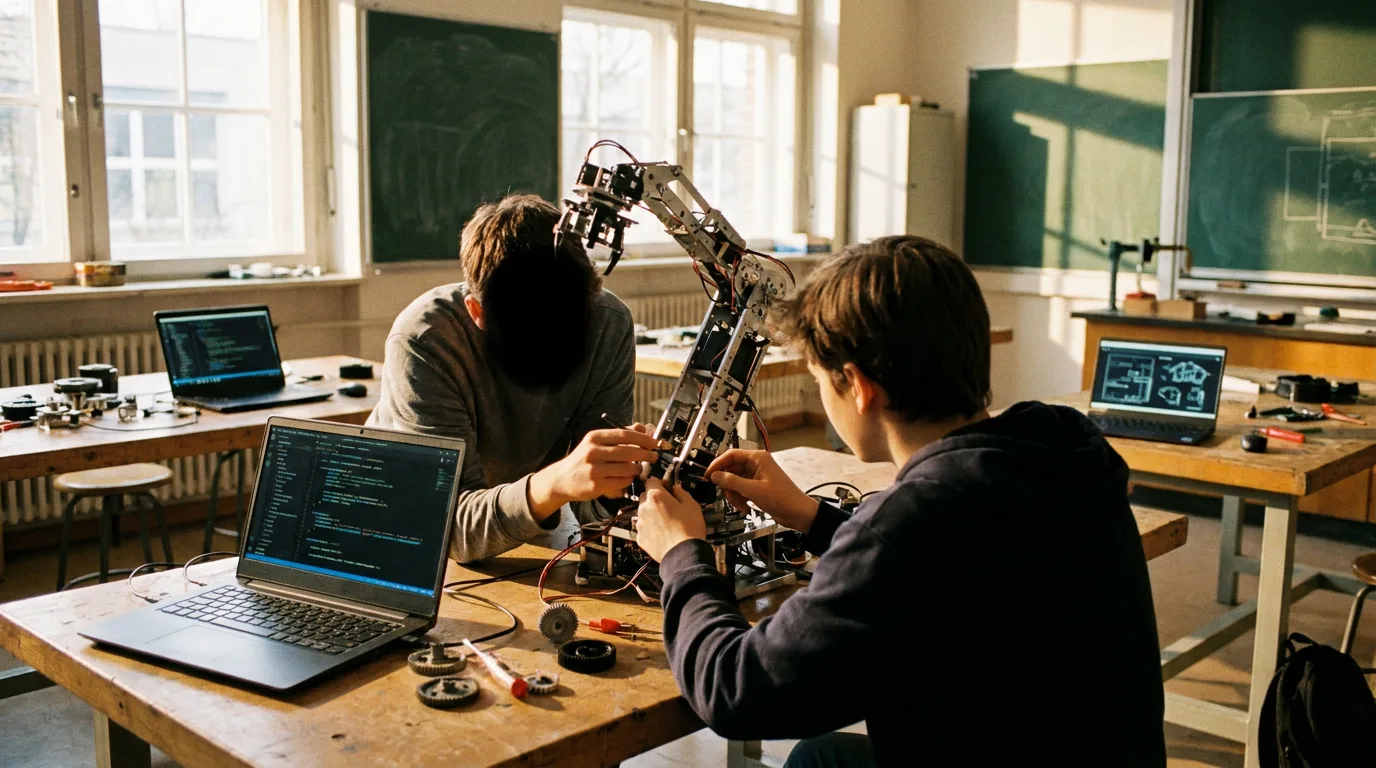
Robotics teaches something AI alone cannot. It requires a child to interact with the physical world, where sensors fail and objects have weight. These projects combine mechanics, electronics, and teamwork to solve real-world problems.
The Risk of Cognitive Dependence
AI can remove the friction from learning, but some friction is educationally valuable. Struggling with a problem develops reasoning and persistence. The objective should be to make AI a cognitive tool, not a substitute for thinking. If a child needs homework support, the goal should be to help them understand the problem rather than simply replacing their effort.
Priorities by Age
There is no rigid formula, but a sensible progression focuses on different milestones as children grow.
Younger Children
Prioritise curiosity, reading, numeracy, and physical play. Children do not need intensive AI training at six years old.
Primary-School Children
Gradually introduce coding and basic digital safety. The emphasis should remain project-based and exploratory.
Teenagers
Develop more sophisticated mathematics, data literacy, and critical evaluation of online information. Older teenagers can begin to specialise in areas like engineering or advanced statistics based on their genuine interests.
What to Look for in STEM Classes
Do not choose a course based on fashionable terminology alone. Look for environments where children build, experiment, and explain their reasoning. The quality of thinking matters more than the number of technological buzzwords.